Clinical problem
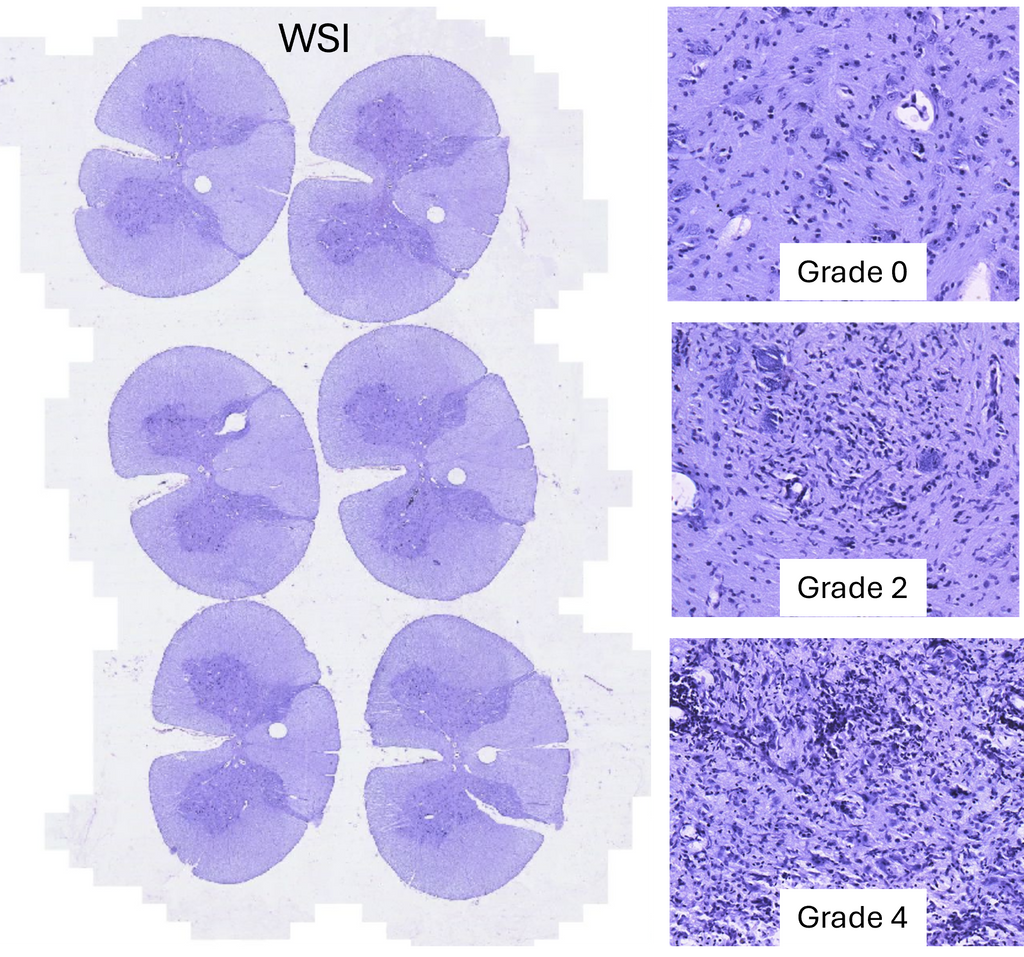
Vaccines must undergo rigorous safety testing before they can be used in humans. Part of this process involves carefully examining tissue samples to detect potential harmful effects. In one such test used during polio vaccine development, experts analyze brain and spinal cord tissue under a microscope and assign a score that reflects the severity of observed damage. This scoring directly influences whether a vaccine batch is considered safe. However, this process is time-consuming and subjective. Different experts may interpret the same tissue differently, making it challenging to achieve consistent and reproducible results, especially at scale. An AI-based solution could support experts by providing objective, consistent, and scalable assessments, ultimately improving both efficiency and reliability in vaccine development.
Approach
In this project, you will develop a deep learning model that can automatically assess tissue samples and predict safety-related scores. A key challenge is that detailed annotations are not available. Instead, you will use weakly supervised learning, where the model learns directly from whole-slide data and overall scores. The project will include: - Developing a model that predicts severity scores from histopathology slides - Building a preprocessing and data curation pipeline - valuating performance across different tissue regions and experimental batches - Investigating how the model improves as more data becomes available
Data
You will work with a dataset of more than 1000 high-resolution histopathology slides, covering multiple regions of animal central nervous system. The data is provided by an industry partner and is part of a real-world vaccine safety evaluation pipeline, making this project highly relevant for practical applications.
Why this matters
Improving the consistency and efficiency of safety testing can: - Accelerate vaccine development - Reduce subjectivity in critical decisions - Support experts in handling large-scale studies - Contribute to safer and more reliable vaccines worldwide
Requirements
- Students with a major in computer science, biomedical engineering, artificial intelligence, physics, or a related area in the final stage of master level studies are invited to apply.
- Affinity with programming in Python and familiar with the deep learning libraries.
- Interest in deep learning and medical image analysis.
Information
- Project duration: 6-9 months, ideally able to start before end of April
- Location: Radboud University Medical Center
- You will be part of the Diagnostic Image Analysis Group (DIAG) and Computational Pathology Group, whose research focus is the analysis of histopathological slides with deep learning techniques.
- You will have access to and work with a large GPU cluster.
- Note that per our union rules, Radboudumc is unable to provide compensation for Master’s thesis projects. Relatedly, we are also unfortunately unable to sponsor those that require a visa for the Netherlands for Master’s thesis projects.
- For more information please contact Maria Ferrandez (mariacristina.ferrandez@radboudumc.nl).