Background
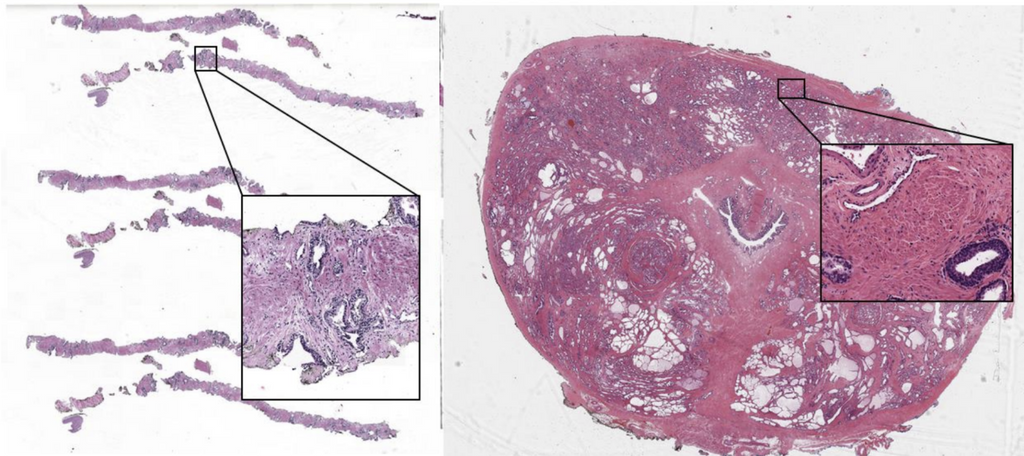
Molecular alterations, such as Microsatellite Instability (MSI), Homologous Recombination Deficiency (HRD), and specific gene mutations, play a critical role in modern oncology. They are essential 'omics biomarkers for selecting patients for targeted therapies and immunotherapies. Currently, determining the presence of these biomarkers requires expensive, tissue-consuming, and time-intensive molecular testing, such as next-generation sequencing. However, these underlying genomic alterations often manifest as distinct morphological patterns within the tumor and its microenvironment. In this project, you will harness the power of artificial intelligence to predict these crucial 'omics biomarkers directly from routinely available hematoxylin and eosin (H&E)-stained histopathology slides. Because biomarkers like MSI have therapeutic relevance across many solid tumor types, your research will take a pan-cancer approach. You will leverage state-of-the-art pathology foundation models and weakly-supervised learning techniques to extract robust representations from gigapixel whole-slide images, learning directly from clinical ground-truth labels without the need for exhaustive manual annotations. Furthermore, clinical adoption of AI requires transparency. A major focus of your project will be developing and evaluating explainability methods. By "opening the black box," you will help pathologists and oncologists understand the morphological features driving the AI’s predictions, building clinical trust and potentially discovering novel visual correlates of underlying genomic alterations.
Tasks and responsibilities
- Develop and optimize weakly-supervised deep learning algorithms and adapt pathology foundation models to predict 'omics biomarkers (e.g., MSI) across diverse cancer types.
- Investigate and pioneer explainability techniques to make complex neural network predictions transparent and interpretable for clinical end-users.
- Process and analyze massive, multi-centric datasets of oncological whole-slide images with matched molecular ground-truth data.
- Collaborate closely with pathologists, oncologists, and (inter)national machine learning researchers to validate the clinical and biological relevance of your developed algorithms.
- Have fun interactions with colleagues, present at local and (inter)national conferences, publish in high-impact technical and medical journals, and develop yourself as an independent researcher.
Profile
You are a creative, highly motivated, and ambitious researcher with an MSc degree in Computer Science, Artificial Intelligence, Data Science, Biomedical Engineering, Technical Medicine, or a related field. You possess a clear interest in applying artificial intelligence to medical image analysis to improve patient care. Solid programming skills (preferably in Python) and practical experience with deep learning frameworks (e.g., PyTorch) are essential and should be evident from your prior projects, publications, or GitHub account. Experience with computer vision, foundation models, weakly-supervised learning, or computational pathology is considered a strong plus. Good communication and organizational skills are crucial, as you will be working in a dynamic, multidisciplinary team.
Organization
The Computational Pathology Group is a research group of the department of Pathology of the Radboud University Medical Center (Radboudumc). We are also part of the cross-departmental Diagnostic Image Analysis Group (DIAG) at Radboudumc, with researchers in the departments of Radiology and Nuclear Medicine, Pathology and Cardiology.
We develop, validate and deploy novel medical image analysis methods, usually based on deep learning technology and focusing on computer-aided diagnosis (CAD). Application areas include diagnostics and prognostics of breast, colon, prostate and lung cancer, among others. Our group is among the international front runners in the field, evidenced for instance by the highly successful CAMELYON and PANDA Grand Challenges which we organized and published in JAMA and Nature Medicine.
Radboud university medical center is a university medical center for patient care, scientific research, and education in Nijmegen. Radboud university medical center strives to be at the forefront of shaping the healthcare of the future. We do this in a person-centered and innovative way, and in close collaboration with our network. We want to have a significant impact on healthcare. We want to improve with each passing day, continuously working towards better healthcare, research, and education. And gaining a better understanding of how diseases arise and how we can prevent, treat, and cure them, day in and day out. This way, every patient always receives the best healthcare, now and in the future. Because that is why we do what we do.
Read more about our strategy and what working at Radboud university medical center means. Our colleagues would be happy to tell you about it. #weareradboudumc
Application
Please apply before May 7th, 2026 via this link. If you have any questions about the position, do not hesitate to contact Nadieh Khalili (nadieh.khalili@radboudumc.nl) or Geert Litjens (geert.litjens@radboudumc.nl)