"External Test of a Deep Learning Algorithm for Pulmonary Nodule Malignancy Risk Stratification" — in Radiology
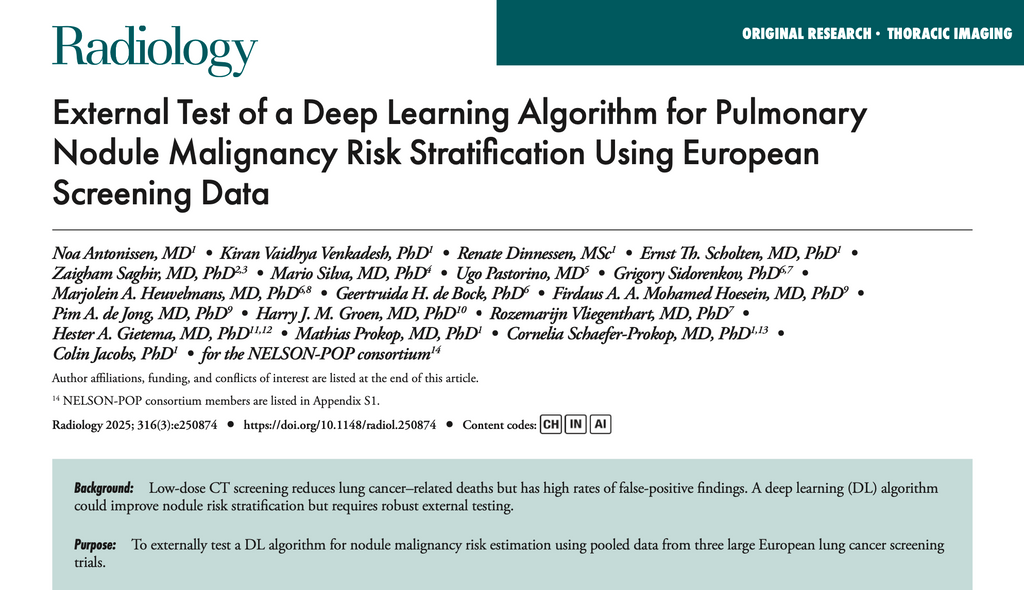
Outcomes of a retrospective external validation of a deep learning (DL) algorithm for pulmonary nodule malignancy risk stratification using European lung cancer screening data have been published in Radiology.
The study tested a DL algorithm - originally trained on National Lung Screening Trial data - using baseline low-dose CT scans from three large European lung cancer screening trials: the Danish Lung Cancer Screening Trial, the Multicentric Italian Lung Detection trial, and the Dutch–Belgian NELSON trial.
👉 Read the full publication here, or the news item on the website of Radboudumc!
𝗦𝘁𝘂𝗱𝘆 𝗢𝘃𝗲𝗿𝘃𝗶𝗲𝘄 🧪 The pooled cohort included 4,146 participants with 7,614 benign and 180 malignant nodules. Performance of the DL algorithm was compared with the widely used Pan-Canadian Early Detection of Lung Cancer (PanCan) model across the entire dataset and challenging subsets of indeterminate nodules (5–15 mm) and size-matched cancer/benign pairs.
𝗞𝗲𝘆 𝗢𝘂𝘁𝗰𝗼𝗺𝗲𝘀 📈 The DL algorithm achieved AUCs of 0.98, 0.96, and 0.94 for cancers diagnosed within 1 year, 2 years, and throughout screening, respectively—matching or exceeding PanCan (0.98, 0.94, and 0.93). In the indeterminate nodule subset (5–15 mm), DL significantly outperformed PanCan across all timeframes (AUCs: 0.95, 0.94, 0.90 vs 0.91, 0.88, 0.86; all P < .05). At 100% sensitivity for cancers diagnosed within 1 year, DL classified 68.1% of benign nodules as low risk compared to 47.4% for PanCan, representing a 39.4% relative reduction in false positives. In the size-matched subset, DL reached an AUC of 0.79 versus 0.60 for PanCan (P < .01).
𝗖𝗹𝗶𝗻𝗶𝗰𝗮𝗹 𝗣𝗲𝗿𝘀𝗽𝗲𝗰𝘁𝗶𝘃𝗲 🩺 These results show that deep learning can substantially reduce false positives in lung cancer screening while maintaining high sensitivity. This could potentially reduce unnecessary follow-up scans, costs, and patient anxiety.
Congratulations to Noa Antonissen, Kiran Vaidhya Venkadesh, Renate Dinnessen, Ernst Scholten, Cornelia Schaefer-Prokop, Colin Jacobs, and the rest of the NELSON-POP consortium for their work!
← Back to overview